
The Full-Time Job Nobody Hired Me For
- chloewigg

- Apr 29
- 4 min read

Last week, I had to prove I'm a business.
Not to a client. Not to a gallery. To the government, to access support that, as a person with a disability, I am supposed to be entitled to. Ten years into my career as a sole trader, ten years of exhibitions, artworks sold, communities built, and I had to justify my existence as a professional.
The catch? I also had to prove I'm profitable.
Here's the thing about being a disabled artist trying to run a small business: every dollar that comes in goes straight back out. Not on rent or marketing or the kinds of costs that make a business look "normal." On equipment to compensate for what my body can't do. On subcontracting the work I'm physically unable to complete myself. The business isn't failing. It's being cannibalized by the cost of my disability, and the system can't tell the difference.
And there's something else the system doesn't account for. I can only take on so many projects. There are only so many hours I can work, only so many commissions I can accept, only so much that is physically possible. That means there is only ever so much money that can come in. I don't charge people more simply because I am disabled. I don't double my rates because it takes me three times as long as the next person to achieve the same result, because that isn't how art works, and it isn't how the world works. So judging whether a sole trader is eligible for help based on how much money they're pulling in, and whether that balances against the hours worked, is deeply troubling. It assumes a level playing field that has never existed for me.
I've been asking for help since January. Four months. I've reached out to an organisation whose entire purpose is to assist people like me, and they are still arguing amongst themselves about how to classify a sole trader of ten years.
While I waited, I did a little audit of my own.
If you've spent any time around someone with a serious chronic illness or disability, you've probably heard the joke: being sick is a full-time job. I've said it myself, usually with a tired laugh.
So I decided to test it.
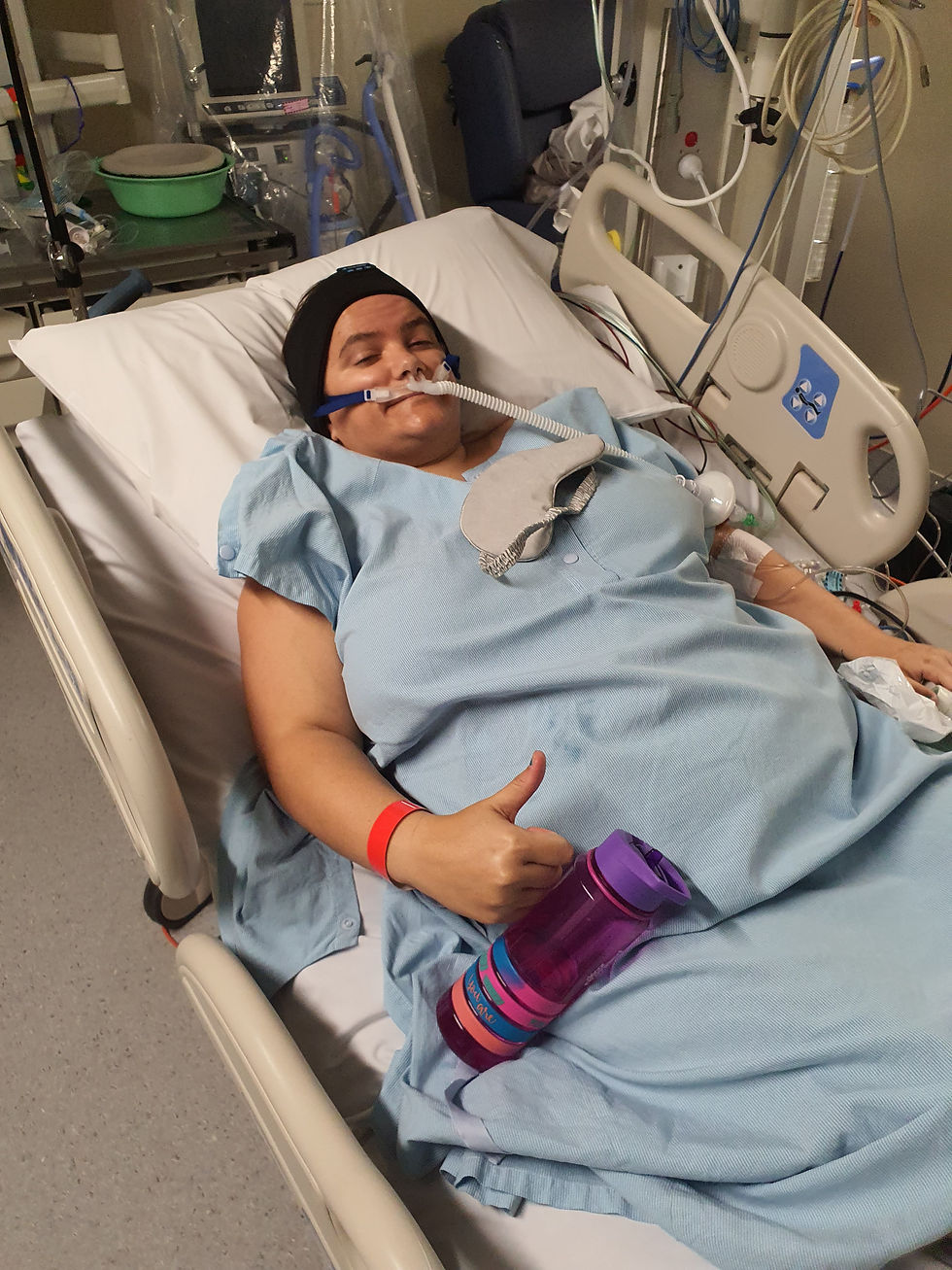
Over the last 13 weeks, including three weeks of holidays where I attended only one appointment, my life-preserving IVIG infusion, I tracked the hours I spent at medical appointments, in transit to them, at allied health visits, and in hospital.
260 hours. In 13 weeks.
That's 20 hours a week. A part-time job at minimum wage would earn you something. This earns me staying alive and as functional as possible.
And that number doesn't include medication administration. It doesn't include pharmacy visits or liaising with the compounding chemist. It doesn't include the time spent putting on braces, or the daily labour of managing my own body and its needs at home.
Just appointments. Just the showing up.
In those 13 weeks, there were also two hospital admissions. I want you to know that, not for sympathy, but because it is ordinary. That is simply what my life looks like.

The conversation around disability in this country, and honestly in most places, has become deeply dehumanising. People talk about what disabled people deserve as though we are a policy problem to be solved, a budget line to be trimmed, a burden to be assessed and weighed.
I want to tell you who I actually am.
I am a mother. A wife. A daughter. An artist. A friend. I make exhibitions that bring people together and chip away at isolation, and I believe in that work with everything I have. I am also someone whose body requires 20 hours a week of medical management just to keep going.

Both of those things are true at once. They don't cancel each other out. But the system seems to need me to be one or the other.
I want to talk about money, because I think it matters and people don't say it plainly enough.
I went from earning a real salary to earning nothing. My husband is wonderful, genuinely, and he has never once made me feel like his earnings are his. He says we're married, it's ours. He means it.
But there is something that happens inside you when you cannot buy a new bra without doing a mental calculation about whether you can justify it. When you want a haircut and you know you can't book the next one six weeks later the way you're supposed to, because there simply isn't enough. When the fruit of your own labour, your art, made with your hands and your vision and your discipline, gets swallowed up not by ordinary business costs but by the cost of your limitations.
That is not a partnership problem. That is a systemic one.
My art gives me a small piece of independence. It matters enormously, not just financially, but as proof to myself that I am still someone who makes things, contributes things, has value beyond what I cost. Watching that get eroded is devastating in a way that's hard to put into words.
I am exhausted.
Not in the way you are after a hard week. In the way that comes from years of fighting for recognition, for access, for the basic dignity of being seen as a whole person, while also managing a body that requires 260 hours of medical attention every three months just to keep going.
I cannot keep doing all of it. And I shouldn't have to be profitable to deserve help.
If you're reading this and you recognise something of yourself in it, the invisible hours, the impossible math, the grinding indignity of having to prove your worth to systems that were never designed with you in mind, I see you. I don't think we're alone. I just think we're very, very tired.
And I think it's time to say that out loud.



Comments